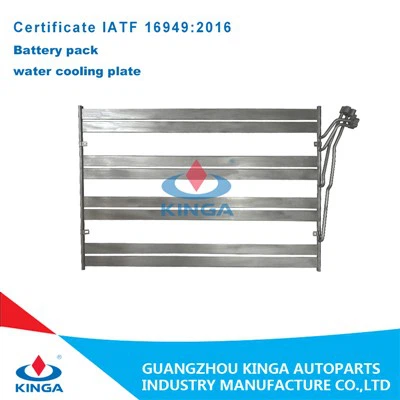
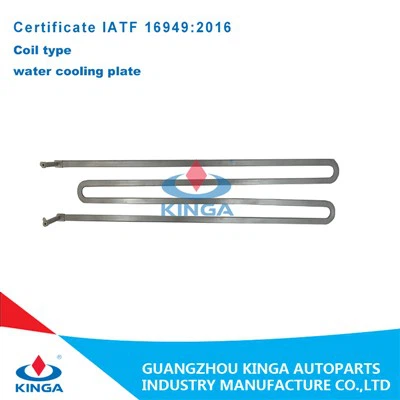
DAIHATSU Brazed Radiator welding process
After several years of practical use, people find the fly in the ointment of DAIHATSU Brazed Radiator, is DAIHATSU Brazed Radiator installed after use for some time, prone to seepage of water in the weld problems. After careful analysis, the experts found that there are two main reasons: the first objective factor, the introduction of this product is not fully in line with China's national conditions, China's current heating operation and management is not very standardized, the heating water quality is not good, water containing Second, the subjective factors, the introduction of this product is a thin steel plate through the rolling process and forming, too many welding spots, the weld is too long. ① piece header (ie, water separator) is made of two thin steel plate were re-rolled and then welding forming, the formation of the first week of the natural seam, including the film at the top of the easy crevice weld; ② riser is a thin steel coil Into a tubular shape, the seam welding process to form a welded steel pipe; (3) and then the riser and the head welding forming DAIHATSU Brazed Radiator monolithic; (4) DAIHATSU Brazed Radiator monolithic connection is welded, and finally formed into a group DAIHATSU Brazed Radiator. During the heating period, it is not always full of water to run. The upper part of the film will have an air layer. After the water supply is stopped and the air is left empty, the residual film at the bottom of the film will be hard to drain. Therefore, the top and bottom welds are the most vulnerable to corrosion. This shows that the pipe-type DAIHATSU Brazed Radiator welding manufacturing process led to more solder joints and weld length. In order to prevent corrosion leaking DAIHATSU Brazed Radiator, manufacturers have to study a variety of remedial measures, such as DAIHATSU Brazed Radiator internal use of a variety of coating anti-corrosion, DAIHATSU Brazed Radiator with magnesium rod to protect the anti-corrosion and so on, can not fundamentally To solve the problem of corrosion leaking. The DAIHATSU Brazed Radiator, which was originally proactively preserved, has been made passive.
DAIHATSU Brazed Radiators are now generally used for cooling high-power electronic components and are widely used because of their excellent heat dissipation. Although the effect of DAIHATSU Brazed Radiator is very good, but DAIHATSU Brazed Radiator is also required for the working environment, the following details the environmental requirements of DAIHATSU Brazed Radiator.
1. The quality of the cooling water should have certain requirements The resistivity of circulating water should not be less than 2.5Ki2, PH value between 6} 9; inlet water temperature is not higher than 35 ℃, water flow of 4 a 8L / min;
2. When used in high voltage or higher voltage devices, the above water quality requirements or higher water quality requirements must be ensured;
3.DAIHATSU Brazed Radiator At work, special attention should be leaking water, anti-clogging, anti-condensation.
4. DAIHATSU Brazed Radiator blades shall be installed along the direction of the cooling air flow during installation of the DAIHATSU Brazed Radiator; the inlet air temperature is not higher than 400 ° C and the inlet side speed is 4 - 6 mls;
5. DAIHATSU Brazed Radiator has the characteristics of wind resistance parameters. When selecting DAIHATSU Brazed Radiator in the whole machine, the relationship between the thermal resistance, flow resistance and wind speed of DAIHATSU Brazed Radiator should be checked according to the load requirements and fan capacity. Considering DAIHATSU Brazed Radiator Thermal resistance and wind resistance two parameters.